


- Generality
- Reagent Availabiltiy
- Experimental User Friendliness
- Criteria #4
- Criteria #5
-
General Characteristics
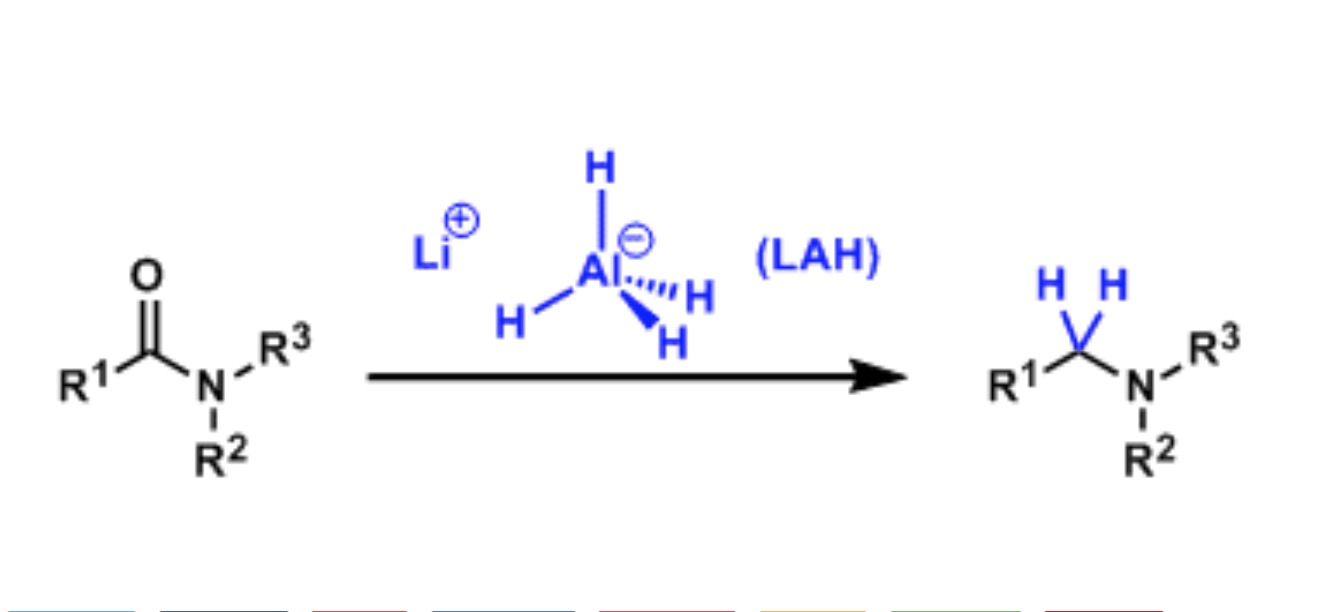
Lithium Alminum Hydride (LAH) is a powerful reducing reagent with the specific formula of LiAlH4. LAH reduces not only ketones and aldehydes but also carboxylic acids and esters to alcohols. It also reacts with nitriles and amides to give amines. LAH reacts with halogenated compounds and sulfonyl compounds to give hydrido substituents. LAH reacts with epoxides to give ring-opening products. Dehydrated THF and diethyl ether are used as solvents because they do not react with LAH and show preferable solubilizing properties. LAH reacts violently with water and protic solvents and generates hydrogen gas. Thus, water and protic solvents must not be used as a reaction solvent.
-
General References
- Brown, W. G. Org. React. 1952, 6, 469.
- Brown, H. C.; Krishnamurthy, S. Tetrahedron 1979, 35, 567. doi:10.1016/0040-4020(79)87003-9
-
Reaction mechanism
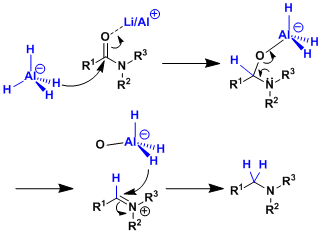
Note that this is a very simplified mechanism, and the reality is more complicated.
-
Modified Example
By mixing aluminum trichloride and LAH in the proper quantity ratio, alanes (AlH3)[1] can be formed in the system. This reagent acts as a powerful reducing agent with strong Lewis acidity, frequently being used in the 1,2-reduction of α,β-unsaturated carbonyl compounds.[2].

-
Tips
Since LAH is highly reactive, as mentioned above, it must be carefully decomposed during treatment after the reaction is completed. Depending on the treatment method, a large amount of insoluble precipitate containing aluminum hydroxides may be generated. If the target product is adsorbed on this precipitate, it may cause a decrease in product yield. Several techniques are known to prevent this issue.
- To a reaction solution reduced with X g of LAH, slowly drop X mL of water, X mL of 15% sodium hydroxide solution, and 3X mL of water in sequence, and stir at room temperature for a while. When a gray precipitate forms, suction-filtrate using Celite(R) and wash with at least 50X mL of solvent. Remove the solvent to obtain the target product.
- Add a large amount of glauber’s salt (sodium sulfate decahydrate) to decompose LAH. Add ethyl acetate and stir until further dissolved; filter the insoluble material using Celite(R) and remove the solvent in vacuo to give the product.
- A saturated aqueous solution of Rochelle salt (sodium potassium potassium tartrate) is added slowly at low temperature and stirred for about 30 minutes, after which the aluminum salt forms a chelate complex with tartaric acid and dissolves. This is then extracted to give the product.
- The reaction is stopped by cooling to 0 °C and adding a saturated aqueous ammonium chloride solution. To this gray emulsion is added a mixture of triethylamine/methanol/ethyl acetate 3:10:87 (2.5 times the volume of the reaction solvent THF) and filtered through Celite(R). The filtrate is extracted to give the desired product.
-
References
[1] Brown, H. C.; Krishnamurthy, S. Tetrahedron 1979, 35, 567. doi:10.1016/0040-4020(79)87003-9
[2] Raghavan, S. et al. J. Org. Chem. 2002, 67, 5838. DOI: 10.1021/jo015921m
-
Related Reactions
-
Related Books
[amazonjs asin=”0198556640″ locale=”JP” title=”Oxidation and Reduction in Organic Synthesis (Oxford Chemistry Primers, 6)”]
-
External Links
- Lithium Alminium Hydride – Wikipedia