


Chemical analysis using neutrons may be less familiar as compared to X-ray or electron beam analysis. The neutron beam experiment has become popular in recent years as it allows us to collect data that are otherwise difficult to obtain. This article outlines the basics of neutron beam analysis, with an emphasis on the Japanese facility environment.
What is Neutron?
The neutron is a subatomic particle that, along with the proton and electron, makes up an atom. Neutron was discovered by James Chadwick in 1932. A carbon atom, for example, consists of a nucleus with six protons, five to eight neutrons, and six electrons surrounding the nucleus. The number of protons determines the element. The number of neutrons in combination with the number of protons creates different types of atoms, called isotopes. For example, a carbon atom with six protons, six neutrons, and six electrons is designated 12C. Nearly 99% of carbon in nature is 12C, but about 1% is 13C, which has seven neutrons. The so-called hydrogen atom is composed of a proton and an electron, but an atom with a neutron attached to the proton is distinguished as an isotope called deuterium.
The neutron is almost the same size as the proton, about 10-15 m. Since the water molecule is about 10-8 m in size, it is a very small particle even in the molecular world. Neutrons weigh almost the same as protons (about 0.14% heavier than protons). Neutrons ejected from the nucleus due to nuclear reactions are called neutron beams. Since particles this small have the characteristics of waves while being particles, it is possible to observe changes in the waves of neutron beams by applying them to a sample and inducing phenomena similar to those of light, such as scattering and diffraction. Neutron beams have several characteristics that clearly distinguish them from X-rays and electron beams[1].
Characteristics of Neutron
- No electric charge: protons have a positive charge and electrons have a negative charge, whereas neutrons have no electric charge.
- Interacts with nuclei, not electrons: Neutrons are less likely to interact with electrons but more likely to interact with nuclei. This is in contrast to X-rays and electron beams, which tend to interact with electrons.
- High penetrating power: X-rays and electron beams tend to interact with electrons contained in materials and are scattered or absorbed as soon as they enter the sample. It is difficult to penetrate deep inside that sample. In contrast, neutrons have no charge and are less likely to interact with electrons, allowing them to penetrate deep into the sample and be analyzed.
- Sensitive to light elements: The reactivity of neutrons is independent of atomic number; with X-rays, for example, the sensitivity increases with heavier elements that have more electrons (Figure 1, top). In contrast, neutrons are sensitive to light elements such as hydrogen and lithium, which are difficult to detect with X-rays (Figure 1, bottom).
- Isotopes can be distinguished: The reactivity of neutrons differs greatly from one isotope to another. Therefore, specific isotopes, such as hydrogen (proton, 1H) and deuterium (2H, D), can be distinguished and analyzed (Figure 1, bottom).
- Magnetic: Neutrons themselves do not carry any charge, but they have the property of small magnets due to their spin (spin quantum number is 1/2). Therefore, the magnetic properties of a sample can be studied.
- Sensitive to atomic and molecular structure: Neutrons, with their wave nature, have a wavelength similar to that of an atom. Therefore, when neutrons are scattered from a sample, they show an interference pattern that reflects the arrangement of the atoms in the sample. This pattern can also be used to study molecular structure.
- Sensitive to atomic and molecular motion: When neutrons are scattered by the sample, the velocity of the neutrons detected changes if the sample is in motion. By observing this change in velocity, we can observe how the material is moving.
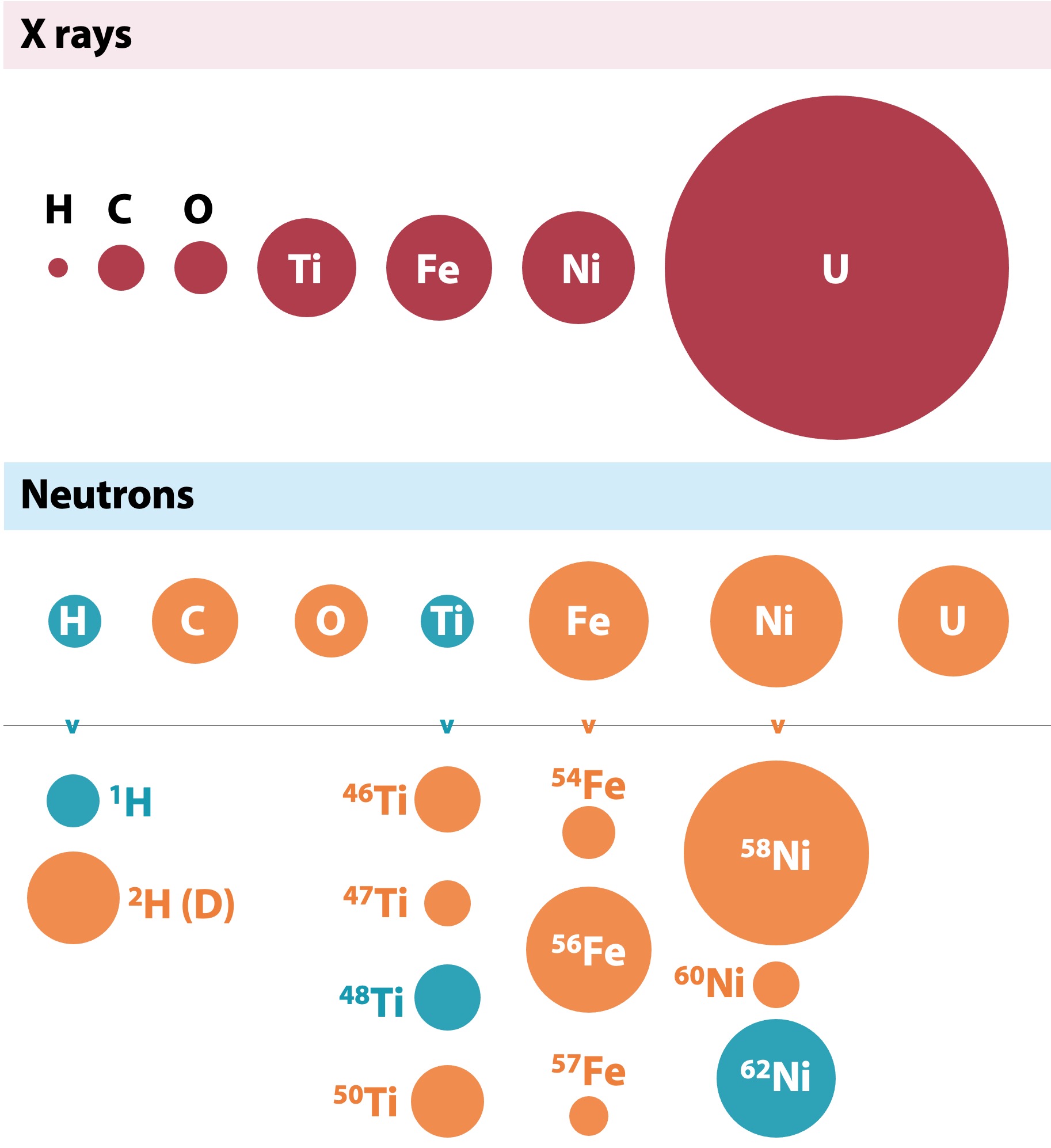
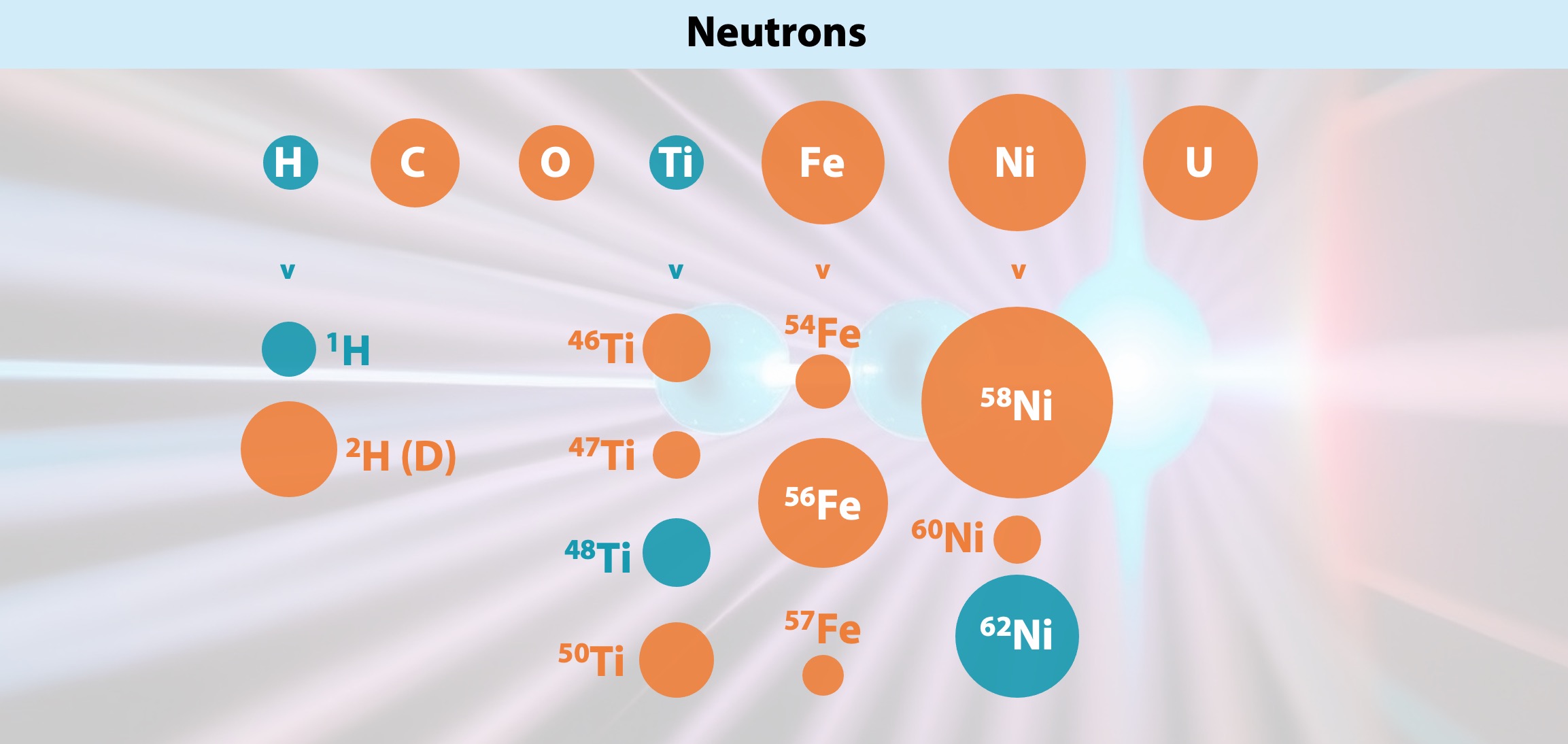
Figure 1: Comparison of X-ray and neutron scattering lengths for hydrogen, carbon, oxygen, titanium, iron, nickel, and uranium. The size of each circle represents the relative scattering length scale. (Top: X-rays) X-rays are scattered by electrons, so heavy elements with a large number of electrons have an increased scattering length (easier to detect). (Bottom: neutrons) Neutrons are scattered from nuclei, so the scattering length depends on the type of nucleus (isotope). Blue-colored elements-isotopes show negative scattering lengths. The top row is the isotope-averaged value when measured at the natural abundance ratio. Figure modified from Ref [1a].
How to Generate Neutron Beams?
Accelerators: High-energy neutron beams for neutron experiments are generated using accelerators. Various accelerators have been constructed in Japan, including the J-Parc facility in Tokai-mura, Ibaraki Prefecture. Hydride is accelerated in a linac (linear accelerator) and punched through a graphite foil that strips two electrons orbiting the hydride ions. The remaining protons enter a synchrotron (circular accelerator), where they are stored with other protons in a pulse that is fired into a container of liquid mercury or other material. When the protons collide with the nuclei of heavy metals, they launch short, intense pulses of neutrons. These neutrons then travel through the beamline to the various instruments and detectors used in the experiment for analysis. When protons collide with heavy metal nuclei, they simultaneously emit a variety of other subatomic particles (muons, neutrinos, antiprotons, etc.), so large facilities are also used for experiments that make use of these subatomic particles.
Nuclear reactors: Neutron beams produced by fission reactions are irradiated. In Japan, the JRR-3 of the Japan Atomic Energy Agency in Tokai-mura, Ibaraki Prefecture, and the research reactor KUR of the Institute for Complex Nuclear Science of Kyoto University in Kumatori Town, Osaka Prefecture, are used for this purpose.
Other neutrons are also produced by nuclear fusion and radioactive isotope decay (e.g., 252Cf), but it is difficult to produce high-energy neutrons that can be used for spectroscopic purposes.
What can we learn from neutron beam analysis?
Various analytical methods are known to take advantage of the unique characteristics of neutrons; they provide complementary information to methods that use X-rays or electron beams. Below are typical classes of experiments used in chemical research. In addition to chemical analysis, neutrons are widely used in particle physics and space science experiments, research to reduce the lifetime of radioactive waste, and medical treatment such as cancer therapy using boron neutron capture therapy (BNCT).
1. Elastic Neutron Scattering, ENS
- Single-crystal Neutron Diffraction
- Powder Neutron Diffraction
- Neutron Total Scattering
- Small Angle Neutron Scattering, SANS
- Neutron Reflectivity Measurement
2. Inelastic Neutron Spectroscopy, INS
- Neutron time-of-flight scattering (meV ~eV)
- Neutron backscattering (µeV)
- Neutron Spin Echo, NSE (neV)
3. Neutron Imaging & Analysis
- Neutron Imaging
- Neutron Activation Analysis, NAA
Related Links
References
- (a) Mason, T. E. Physics Today 2006, 59, 44–49. https://doi.org/10.1063/1.2216961 (b) Yu, X.; Cheng, Y.; Li, Y.; Polo-Garzon, F.; Liu, J.; Mamontov, E.; Li, M.; Lennon, D.; Parker, S. F.; Ramirez-Cuesta, A. J.; Wu, Z.Chemical Reviews 2023, 123, 8638–8700. https://doi.org/10.1021/acs.chemrev.3c00101.