


Small Angle Neutron Scattering, SANS
Small-angle neutron scattering (SANS) is a neutron analog of Small-angle X-ray scattering (SAXS). By measuring neutrons with long wavelengths and small scattering angles, this experimental technique is used to evaluate the nanoscale structures formed by aggregates of atoms and molecules.[1] The size, shape, and inter-particle distance of polymers, proteins, and nanopowders can be evaluated over a scale from nm to sub-µm. The method is classified as elastic neutron scattering (ENS).
Applications
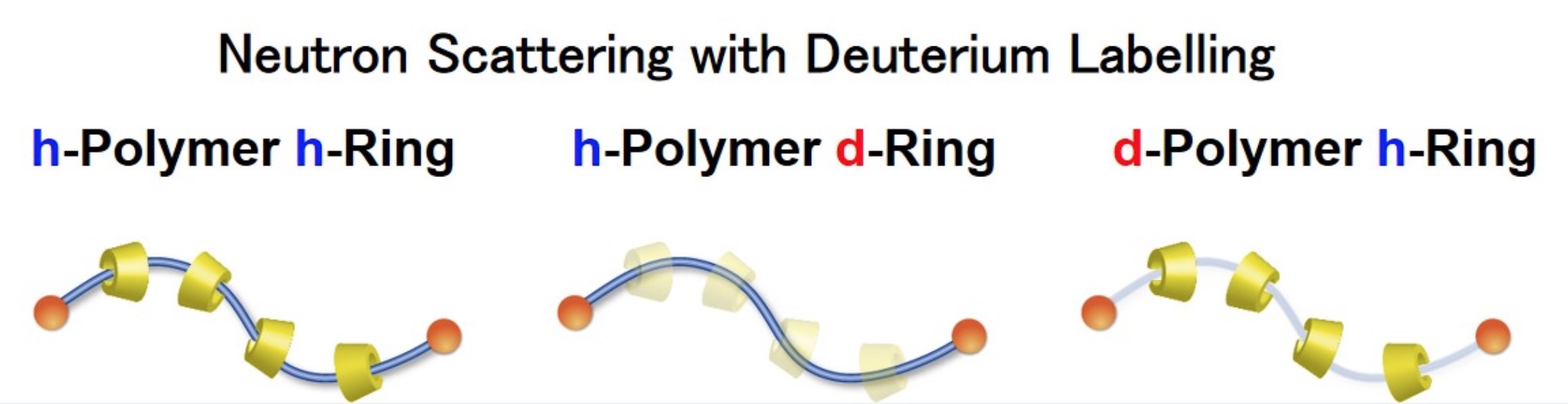
For example, by taking advantage of differences in isotope scattering lengths, it is possible to perform contrast-controlled structural analysis by deuterating only the main chains or rings of cyclic polymers (Figure 1). [2]
A similar technique has also been used for domain-selective deuteration of proteins to visualize only a portion of a complex protein (work by Prof. Sugiyama et al., Kyoto University).
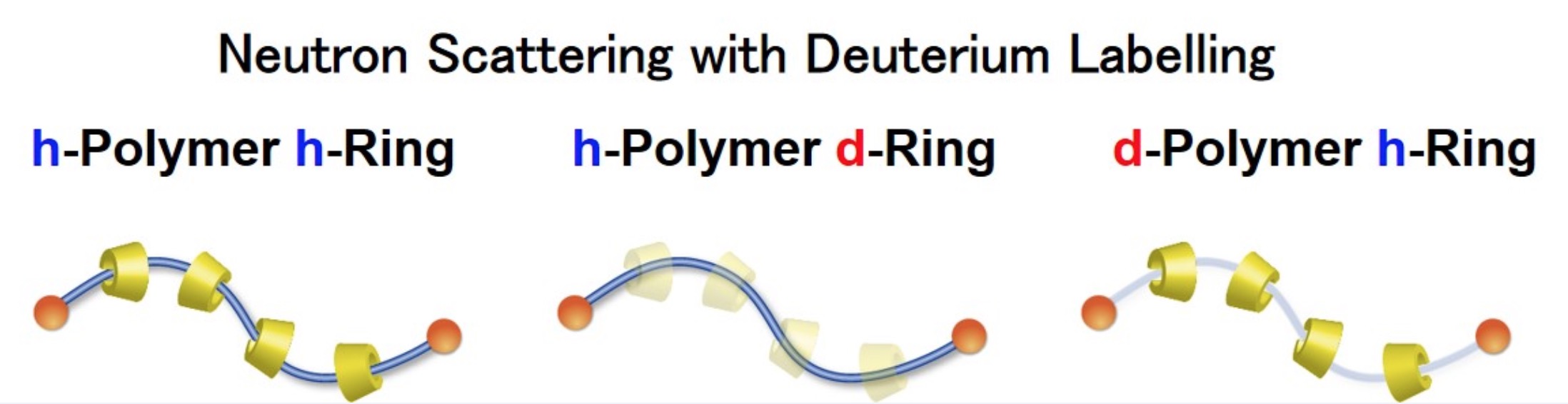
Figure 1: Small-angle neutron scattering analysis of a cyclic polymer utilizing deuteration. Only the deuterated portions are “erased” and the remaining hydrogen can be distinguished and observed. Reproduced from the website of Mayumi Laboratory, The University of Tokyo.
Related Links
- J-Parc MLF website
- Deunet
- Deut-Switch
- Oak Ridge National Laboratory textbook
- Mayumi Laboratory https://kmayumi.issp.u-tokyo.ac.jp/research/
- Wikipedia Small-angle neutron scattering
Reference
- Shibayama, M. Polymer Journal 2011, 43, 18–34. https://doi.org/10.1038/pj.2010.110.
- Endo, H.; Mayumi, K.; Osaka, N.; Ito, K.; Shibayama, M. Polymer Journal 2011, 43, 155–163. https://doi.org/10.1038/pj.2010.124.